Folding Bike Helmets: The Certified Ones You Can Buy in the US
A helmet that collapses into your bag fixes the real reason people ride bareheaded: nowhere to put it. The catch is that many folders still recommended online have been recalled, paused or never shipped.
On this page
A folding bike helmet fixes the most common reason people ride without one: after a share bike or folding ebike trip across town, a regular helmet is a foam bucket you carry until evening. A collapsible helmet goes in a backpack or desk drawer instead.
In 2026, three brands sell folders that their makers say meet the mandatory US standard, CPSC 16 CFR 1203: FEND, a US brand, with the One, Super and Super Plus; Closca, from Spain, with the Helmet Visor and Loop; and Overade, from Paris, with the PLIXI. Maker prices run from about $89 to about $164. FEND sells and ships in the US. Closca runs a US storefront priced in dollars and Overade sells from France, so for those two, confirm delivery at checkout.
They suit bike share riders, folding bike commuters and travelers. They do not suit fast ebike riding: FEND limits its own claim to e-bikes under 20 mph, Overade says the standard its helmet meets applies up to 25 km/h, and no folding helmet holds the Dutch NTA 8776 speed pedelec certification. Meanwhile, plenty of the folders other roundups still recommend have been recalled, paused or never delivered.
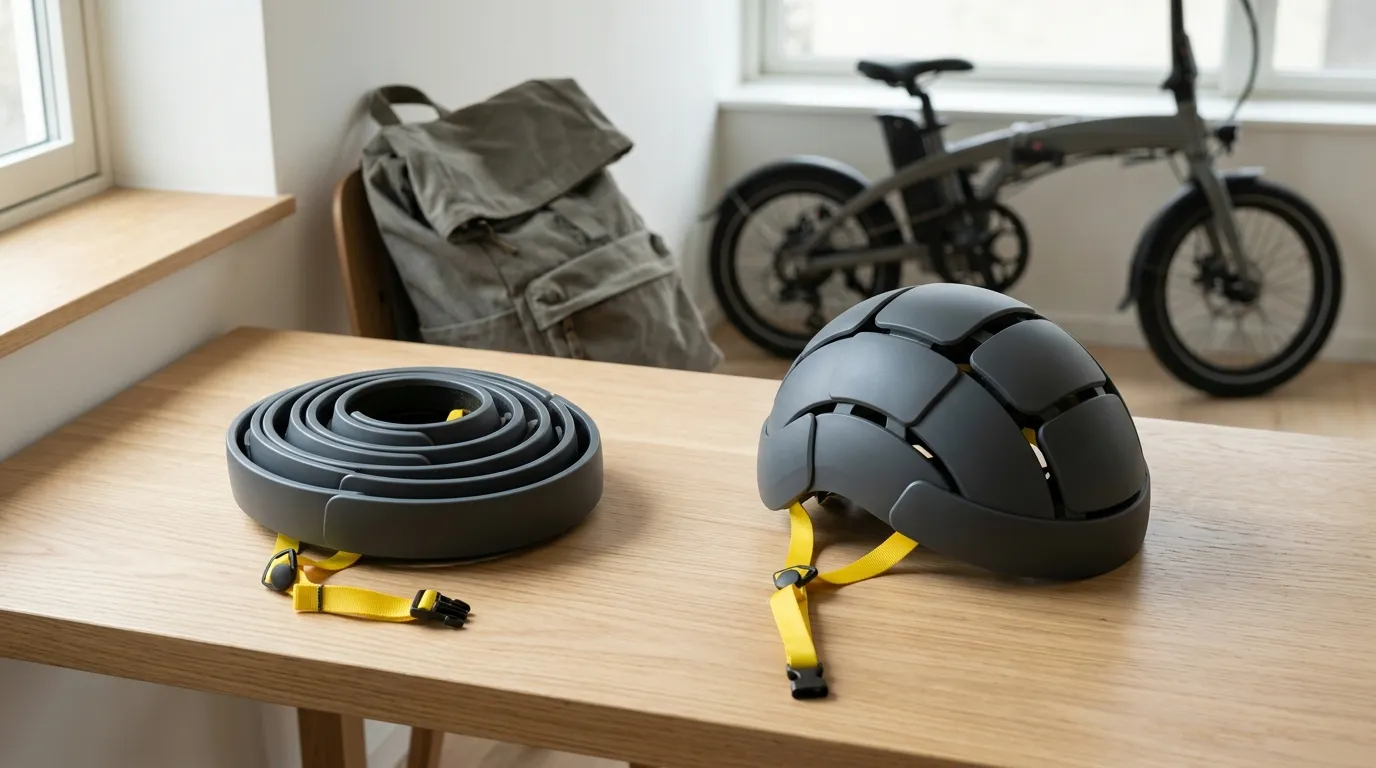
The folding helmets US buyers can get in 2026
Six current models from three brands make the list, and the table shows what each maker publishes, which is less than you might hope. FEND gives no weights and no folded dimensions for any of its helmets.
| Model | Fold type | Folded size | Weight | Sizes | Certification, as the maker states it | Approx. price |
|---|---|---|---|---|---|---|
| FEND One | Side ribs fold in | Not published (FEND says 50% smaller) | Not published | S 54-57, M/L 57-62 cm | CPSC and EN 1078 | about $119 |
| FEND Super | Side ribs fold in | Not published (FEND says 50% smaller) | Not published | S 54-57, M 57-59, L 59-62 cm | CPSC and EN 1078 | about $89 |
| FEND Super Plus | Side ribs fold in, built-in lights | Not published (FEND says 50% smaller) | Not published | S 54-57, M 57-59, L 59-62 cm | CPSC and EN 1078 | about $139 |
| Closca Helmet Visor | Three telescoping rings | 8 cm tall (16 cm open) | 250-290 g | S 54-56, M 57-59, L 60-61.5 cm | EN 1078 and CPSC | about $164 |
| Closca Loop | Three telescoping rings | 8 cm tall (14 cm open) | 340-375 g | M 56-59, L 60-63 cm | EN 1078 and CPSC | $105 to $116 |
| Overade PLIXI | Hinged hard shell | 21 x 11 x 16 cm | 440 g (S/M), 490 g (L/XL) | S/M 54-58, L/XL 59-62 cm | EN 1078 and CPSC | about €109 |
Swipe sideways to see all columns →
The certification column is each maker's own claim. FEND says its helmets are certified to US CPSC and EU EN 1078. Closca states EN 1078 for Europe and Asia and CPSC for the USA and Canada. Overade states EN 1078 in Europe and CPSC in the USA. CE, which turns up in UK roundups, is a marking rather than a test standard, and it is not what US law asks for.
Sizing needs care on two of these. FEND's page for the FEND One shows a size chart of S 54-57 and M/L 57-62 cm next to a details panel reading 54-56 and 56-61 cm. Go by the chart, and size up if you fall between, as FEND's FAQ advises. The Closca Loop starts at 56 cm, so smaller heads should look at the Helmet Visor. Our guide to helmet sizing, fit and safety ratings covers the tape-measure method.
The best folding bike helmets, by what you need
Four models cover the four reasons people shop for a foldable bike helmet. None gets five stars, because each gives something up against a regular helmet. Specs are the makers' own, and prices are approximate list prices from each brand.
Closca Helmet Visor
- Three rings fold to 8 cm (3.1 in) tall, from 16 cm open
- 250-290 g, the lightest published weight here
- Sizes S 54-56, M 57-59, L 60-61.5 cm
- EN 1078 and CPSC, per Closca
This is the current form of the original three-ring Closca foldable helmet, the one older articles call the Fuga; Closca no longer uses that name. It is the flattest and the most expensive folder on the list. The Closca Loop uses the same fold for $105 to $116, but weighs 340-375 g and comes in only two sizes.
FEND Super
- Side ribs fold inward, FEND says by 50%
- Three sizes: S 54-57, M 57-59, L 59-62 cm
- CPSC and EN 1078, per FEND
- Lights sold separately; weight not published
The cheapest folder from a brand that sells and ships in the US, with three sizes covering 54 to 62 cm. FEND also runs a free crash replacement program for helmets damaged in a crash, though it does not spell out the terms. The FEND One, the brand's original, costs about $119 and comes in two sizes rather than three.
FEND Super Plus
- Removable 30-lumen front and rear lights
- IPX6, USB-C charging, up to 15 hours claimed
- Sizes S 54-57, M 57-59, L 59-62 cm
- CPSC and EN 1078, per FEND
Same sizes and certification statement as the Super, plus removable lights front and rear. Helmet lights sit higher than a seatpost light, which helps drivers see you over car roofs, and they leave with you when you lock up. If you ride home after dark, this is the folder.
Overade PLIXI
- Hinged ABS shell over EPS, folds in about 2 seconds
- Packs to 21 x 11 x 16 cm
- S/M 54-58 cm at 440 g, L/XL 59-62 cm at 490 g
- EN 1078 and CPSC, per Overade
The PLIXI hinges into what BHSI calls a chunk rather than a flat disc, and at 440 to 490 g (about 15.5 to 17.3 oz) it is the heaviest helmet here. In return you get a hard outer shell. It gets three stars mainly because buying it from the US is awkward: Overade's free shipping offer excludes the USA, its shipping policy does not list US delivery, and BHSI puts the US price at about $100 plus shipping. Some retailers call it the Plixi Fit; Overade just says PLIXI.
How a helmet folds without losing protection
It rearranges the impact foam into a smaller shape without removing any of it. BHSI makes the point that a folder built from conventional materials still needs the same volume of foam as any other helmet, which caps how small it can get. That is why the flattest folder here goes from 16 cm tall to 8 cm rather than to a flat pad.
Telescoping rings: Closca
Closca splits the helmet into three pieces of polycarbonate and EPS joined by four connectors, each with two stable positions, folded and open, and nothing in between. Closca says the helmet can only fold when there is no interior volume, and its FAQ puts it bluntly: it will never fold while your head is inside.
Ribs that fold in from the sides: FEND
FEND's ribs fold inward from the sides in two sections and lock open with two tabs, according to BHSI, which gives the folded width as about 5 inches. FEND calls it Smart-Fold and says its patented locking system lets the helmet stay open during an impact.
A hinged hard shell: Overade
Overade puts a hinged ABS shell over EPS, with six internal pads. The mechanism only activates when the helmet is empty and clicks when it locks open.
Other makers dropped EPS altogether: Hedkayse used a soft polymer it calls Enkayse, Ventete uses inflatable air ribs, and Newlane a two-piece helmet whose top flips into the bottom ring. None is a US option, for reasons covered below. Whatever the design, BHSI notes that keeping the shell together in a crash takes more engineering and usually costlier materials, which goes a long way toward explaining the prices.
What independent checks and recalls show
Independent evidence on folding helmets is thin and mixed: a handful of lab results, repeated complaints about fit and straps, and two recalls that most roundups leave out.
Lab ratings and field reports
Consumer Reports rated the Overade PLIXI's impact performance Good in 2019 but downrated its fit and ventilation, according to BHSI. BHSI itself reports strap junctions that did not lock or hold on its FEND and PLIXI samples. A junction that slides lets the straps drift and loosens the whole helmet, so recheck yours every few rides.
Virginia Tech's helmet lab publishes independent star ratings for bicycle helmets, the only widely available data that separates two helmets that both pass CPSC. Search the exact model name there before you buy. Many folders have never been rated, which makes them unknowns rather than failures.
BHSI also flags an EU Safety Gate alert against a no-name folder resembling the FEND design that failed the European standard. It is not a FEND product, which is the point: a lookalike has not earned the original's certification.
The Morpher recall, US, 2020
On August 27, 2020, the CPSC recalled the Morpher folding helmet because it did not comply with the federal safety standard for bicycle helmets. About 8,500 had been sold from April 2017 to November 2019 for about $150. The company was no longer in business, and owners were told to stop using the helmet and dispose of it. Consumer Reports had rated it "Don't Buy: Safety Risk" in July 2019, according to BHSI.
The Closca Fuga recall, France, 2025
On February 20, 2025, RappelConso, the French government's official recall site, published a voluntary recall of the Closca FUGA under notice 2025-02-0163. It covers one tested lot made in May 2019, GTIN 8427934791095, sold across France from October 18, 2019 to March 9, 2023. The stated reason is a risk of injury in a mechanical impact, and owners were told to stop using the helmet and return it for a refund.
The notice names only the FUGA and that lot. It does not cover Closca's current Helmet Visor or Loop, for which Closca still states EN 1078 and CPSC certification. The fair reading is that one batch of an older model was recalled over impact protection, and that a secondhand Fuga of unknown origin is not worth the gamble.
What you give up for the fold
Mostly airflow, strap security and money, plus a question no maker answers: how long the mechanism lasts.
Ventilation is the most consistent complaint. Consumer Reports marked the PLIXI down for it, and road.cc's review of the Newlane called venting probably the biggest issue with that design. You will feel it more on a summer commute than on a ten-minute share-bike hop.
Weight varies more by design than by the fact of folding. Published weights run from 250-290 g for the Closca Helmet Visor to 440-490 g for the PLIXI. FEND publishes no weights, so treat any FEND figure on a retailer page as unverified.
Hinge life is unknown. No maker publishes a fold-cycle rating. Closca offers a 3-year warranty and sells spare buckles and visors, and Overade gives a 2-year guarantee, which is the best proxy you have.
After a crash, a folder is done, like any EPS helmet, because the foam crushes and does not spring back. FEND's crash replacement program takes the sting out of that. Hedkayse claimed its polymer helmet could take hundreds of large impacts, but BHSI questioned it, no independent result was published, and Hedkayse's own page still notes that the rules call for discarding a helmet after a severe impact.
What the fold buys you
- A helmet that fits a backpack, desk drawer or carry-on, so it is with you when the share bike is
- Closca folds to 8 cm (3.1 in) tall; the PLIXI packs to 21 x 11 x 16 cm
- The same CPSC certification claim as a regular helmet, from FEND, Closca and Overade
- Nothing to leave clipped to a parked bike
- Free crash replacement on FEND helmets
What it costs you
- Weaker ventilation, per Consumer Reports on the PLIXI and road.cc on the Newlane
- Strap junctions that slipped on BHSI samples
- No fold-cycle rating from any maker
- No MIPS on any folder sold to US buyers
- Speed claims capped at 20 mph (FEND) and 25 km/h (Overade)
- Only two sizes on the FEND One and the Closca Loop
At about $89 to $164, a folder is real money for a helmet you may wear twice a week, but the helmet you carry beats the one you left at home.
Can you wear a folding helmet on an ebike?
Yes on a Class 1 or Class 2 ebike at ordinary speeds; no on a Class 3 bike ridden near its 28 mph assist limit. The makers say as much themselves. FEND says its helmets exceed CPSC and EN 1078 for bicycles, skateboards and e-bikes or scooters traveling under 20 mph. Overade says EN 1078 applies up to 25 km/h, about 15.5 mph, and that the PLIXI is not approved for speed bike users.
CPSC 1203 itself sets no speed rating. It is a drop test at a fixed impact energy, so a speed figure on a product page is the maker telling you how far it will stand behind the helmet. Class 1 and Class 2 bikes stop assisting at 20 mph, right on FEND's line. Overade is stricter: taken literally, a Class 1 bike at full assist is already past its 15.5 mph. A Class 3 ebike assists to 28 mph, well past both.
No folding helmet is certified to NTA 8776, the Dutch standard written for speed pedelecs, which asks for more coverage and a harder impact test. If you hold 25 to 28 mph, wear a full-size helmet with more rear and temple coverage. Our explainer on what an ebike asks of a helmet covers the physics, and our ebike helmet picks include speed pedelec options.
Folding helmets to skip
Skip anything recalled, paused, discontinued or not certified for the US, which removes most of the names on older best-of lists.
- Morpher. Recalled by the CPSC in 2020, as above. The current Morpher site is run by Vigil Helmets Ltd, links to Amazon UK, and says the helmet is not currently certified for sale or use in the USA.
- Closca Fuga. The recalled French lot was made in May 2019, and Closca now sells its ring helmets as the Helmet Visor and Loop. A Fuga listing today is old or secondhand stock you cannot easily trace to a lot.
- Hedkayse ONE. Only ever certified to EN 1078, never CPSC, and Hedkayse says it has hit pause on cycle helmet production. Its shop now sells rugby headguards.
- Carrera Foldable. Gone from Carrera's own stores, where a search for foldable returns only eyewear. BHSI notes the first version was EN 1078 only; Carrera later said CPSC versions existed, but the CPSC status of any leftover stock cannot be verified.
- Park & Diamond. The campaign ended without a helmet ever being delivered, per BHSI. Kova, another folder, shut down in April 2021.
- Newlane. The only folder with a Mips liner, by Newlane's own description, and Brompton stocks it in its UK shop. It is certified to EN 1078 with no CPSC claim, and Newlane does not ship outside the UK and EU.
- Ventete aH-1. An inflatable helmet that deflates to under 4 cm thick. BHSI says it meets European, UK, EFTA and Singapore standards only, so it cannot be sold in the US.
Who should buy a folding helmet, and how to check one
Buy one if your helmet problem is carrying and storage. If it is protection at speed, or you want MIPS, buy a regular helmet.
Good fits
- Bike share riders. A Washington, D.C. study cited by Consumer Reports found 26 percent helmet use among bike-share riders against 70 percent among people on their own bikes, and CR points to the hassle of carrying a helmet. A folder removes most of that hassle.
- Folding bike and folding ebike commuters. If you carry a folding electric bike onto a train or under a desk, a full-size helmet is the bulkiest thing left.
- Travelers. The PLIXI's 21 x 11 x 16 cm package is about 8.3 x 4.3 x 6.3 inches, small enough for a carry-on or a desk drawer.
Better served by a regular helmet
- Class 3 riders at speed, for the reasons above.
- Anyone who wants MIPS in the US. No folder sold here lists it, while many of the regular bike helmets we recommend have it.
- Riders whose helmet can stay with the bike. A regular helmet with a helmet lock solves the carrying problem, though as our guide to helmet accessories explains, those locks only deter opportunists.
Before you buy
- Look for the CPSC certification label inside the shell. A listing that only mentions CE or EN 1078 is not enough for the US.
- Buy from the maker or a seller the maker lists.
- Search Virginia Tech's ratings and recall lists for the exact model; for a European brand, check RappelConso too.
- On arrival, confirm it locks open every time and the strap junctions hold.
- For Closca and Overade, confirm US delivery and returns at checkout.
If you ride an ebike, check what your state requires, because several states require helmets on Class 3 bikes. If the folder is for a fast ebike, start with the ebike helmet guides linked above instead. And if lights are the priority, compare the Super Plus with the turn-signal and crash-detection models in our guide to smart bike helmets.